How Post Vasectomy Pain Starts and What It Can Mean
- 3 days ago
- 5 min read
A sore, bruised feeling for a few days after a vasectomy is expected. Pain that continues, returns after an initially smooth recovery, or begins months or years later deserves a more careful answer. Understanding how post vasectomy pain starts can help distinguish normal healing from a problem that should be evaluated by a urologist who takes chronic scrotal pain seriously.
Post-vasectomy pain is not one single diagnosis. It is a symptom with several possible causes, and the timing, location, and character of the discomfort matter. Some men feel pressure or congestion. Others describe a sharp pulling sensation, burning, tenderness near the epididymis, or pain during ejaculation, exercise, or sex. A proper evaluation should start with the details rather than assumptions.
How post vasectomy pain starts after surgery
Immediately after a vasectomy, the body responds to surgery in predictable ways. The vas deferens has been divided, handled, and sealed. Local tissues can swell, bruise, and become inflamed as they heal. Mild to moderate discomfort during this period is usually related to the procedure itself, not chronic post-vasectomy pain syndrome.
The early healing period can involve aching in the testicles or groin, incision tenderness, and discomfort with movement. Overdoing activity, lifting too soon, or returning to sex before healing is complete can aggravate those symptoms. Most men improve with rest, supportive underwear, ice during the first day or two when appropriate, and the recovery instructions provided by their surgeon.
Pain becomes more concerning when it does not steadily improve, when it is severe, or when it changes after the initial recovery period. Persistent pain beyond several months is often discussed as post-vasectomy pain syndrome, sometimes abbreviated PVPS. The condition is uncommon, but for the men affected, it can interfere with work, sleep, exercise, intimacy, and peace of mind.
The mechanisms behind delayed or persistent pain
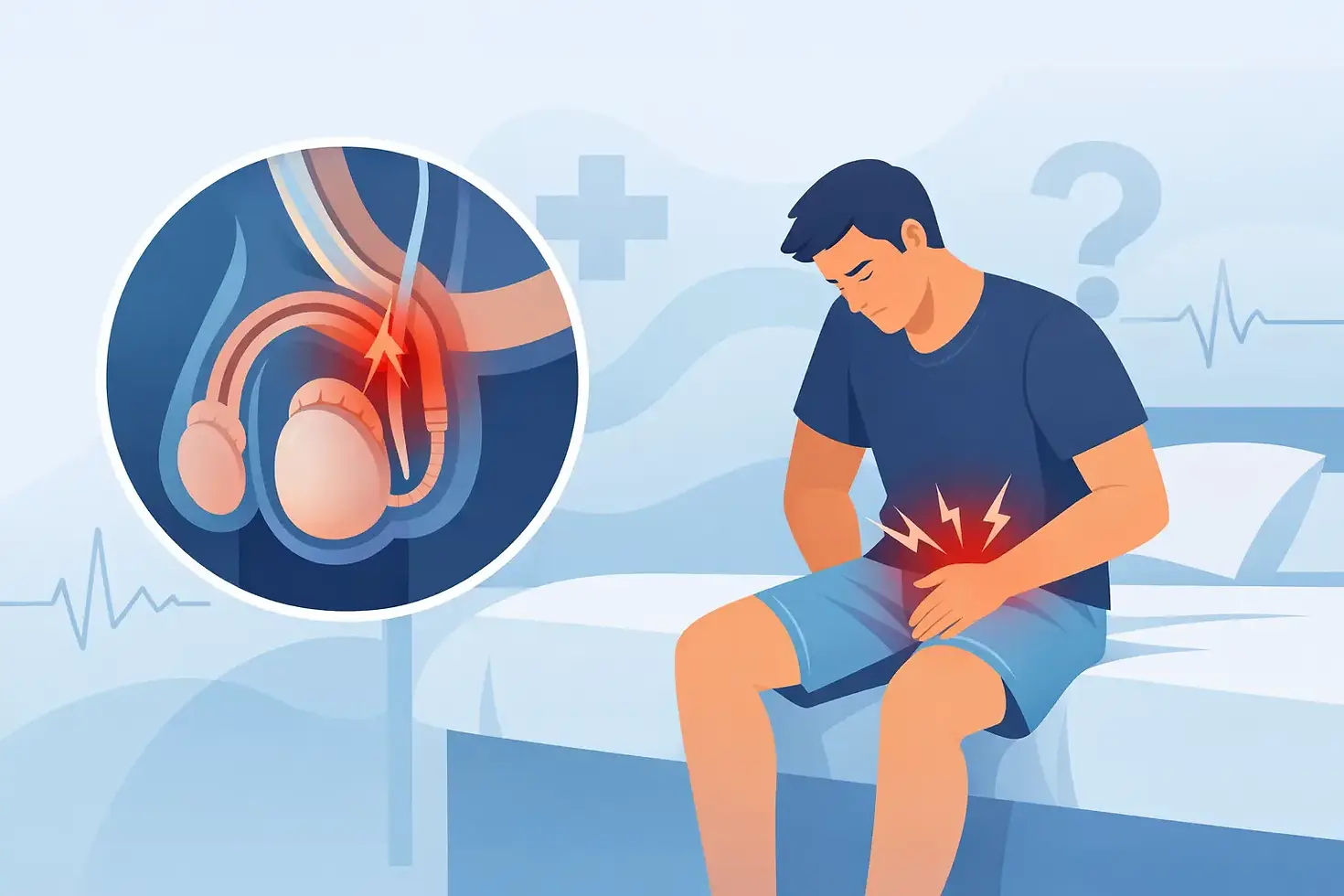
A vasectomy blocks the path sperm normally travel. The testicles continue to produce sperm, but sperm can no longer move through the vas deferens and into the ejaculate. That change can create pressure-related symptoms in some men, particularly around the epididymis, the coiled structure behind each testicle where sperm mature and are stored.
Back pressure and epididymal congestion
For some patients, pressure builds in the epididymis or remaining portion of the vas deferens. The result may be a sense of fullness, aching, or pain that is worse after ejaculation. In some cases, pressure can contribute to inflammation or tiny leaks in the reproductive tract. The body may respond by forming scar tissue or a sperm granuloma, a small inflammatory lump caused by sperm escaping into surrounding tissue.
A sperm granuloma is not always painful. When it is tender, however, a man may notice a distinct sore spot along the vasectomy site or near the upper portion of the testicle. The important point is that a lump or focal tenderness should be examined rather than self-diagnosed.
Nerve irritation or scar-related pain
The scrotum contains a complex network of nerves. Surgical manipulation, inflammation, healing scars, or nerve sensitivity can produce pain that feels sharp, electric, burning, or unusually sensitive to touch. This type of pain may not follow a simple pattern. It can occur at rest, with clothing contact, while sitting, or after physical activity.
Pain can also be referred from the groin, pelvic floor, lower back, hip, or abdomen. That is why an experienced physician should avoid treating every episode of testicular discomfort as a direct consequence of the vasectomy. A careful examination may point to a different source altogether.
Inflammation, infection, or other conditions
Pain that starts soon after surgery may occasionally be related to infection, a hematoma, or significant swelling. A hematoma is a collection of blood in the scrotal tissues and can cause marked bruising, enlargement, pressure, and pain. Infection may cause worsening redness, warmth, drainage, fever, or increasing tenderness.
Later pain may also arise from epididymitis, a hernia, varicocele, hydrocele, kidney stone pain, prostatitis, pelvic floor dysfunction, or a testicular condition unrelated to the vasectomy. A vasectomy history is relevant, but it should not prevent a complete differential diagnosis.
What the timing and pattern can tell you
The way pain begins gives useful clues, although it rarely provides a diagnosis by itself. Pain that begins immediately and improves week by week is more consistent with routine recovery. Pain that persists without meaningful improvement may involve ongoing inflammation, nerve irritation, or healing complications.
Pain that begins months or years later can be harder to interpret. Some men develop intermittent congestion-type discomfort over time. Others may only notice symptoms after a change in exercise, an injury, increased sexual activity, or an unrelated medical issue. Delayed onset does not automatically prove that the vasectomy is the cause, but it does justify a structured evaluation.
Keep track of whether the pain is on one side or both, constant or intermittent, dull or sharp, and connected to ejaculation, standing, lifting, bowel movements, urination, or touch. Those details are more useful to a physician than simply saying that the testicle hurts.
When pain needs prompt medical attention
Severe testicular pain should never be ignored. Sudden, intense pain, especially with nausea, vomiting, or a high-riding testicle, requires urgent evaluation because testicular torsion is time-sensitive. A rapidly enlarging scrotum, fever, spreading redness, drainage from an incision, or pain that is getting worse rather than better also warrants prompt medical care.
For non-emergency symptoms, schedule an evaluation if pain lasts beyond the expected recovery period, repeatedly returns, affects sexual activity or daily function, or causes ongoing worry. Men sometimes minimize this issue because they do not want to seem overly concerned. That is the wrong standard. Persistent scrotal pain deserves a real explanation and a treatment plan based on the likely source.
How a thorough evaluation should work
A proper assessment begins with the history: when the pain started, what makes it worse or better, the type of vasectomy performed, prior infections or injuries, sexual symptoms, and any back, urinary, or pelvic symptoms. The physical examination should assess the testicles, epididymides, vasectomy sites, groin, and possible hernias.
Depending on the findings, a physician may recommend urinalysis, ultrasound, or other testing to rule out infection, masses, fluid collections, and other conditions. Diagnostic nerve blocks can sometimes help clarify whether nerve pathways are contributing to the pain. Treatment should follow the diagnosis, not a generic formula.
Conservative options may include anti-inflammatory medication when medically appropriate, scrotal support, activity modification, treatment for infection when infection is actually present, pelvic floor therapy, or pain-focused approaches. Some men improve without surgery. Others continue to have pain despite reasonable nonoperative care.
Where vasectomy reversal may fit
For carefully selected men whose symptoms appear related to obstruction and pressure, vasectomy reversal can be a meaningful treatment option. Reconnecting the vas deferens may relieve pressure in the epididymis and restore the natural pathway for sperm. It may also restore fertility, which matters to men who want the option of biological children again.
But reversal is not a universal cure for every form of post-vasectomy pain. If pain is primarily nerve-related, referred from another area, or caused by a condition unrelated to the vasectomy, a reversal may not address the real problem. That is why the diagnosis comes first.
The operation itself also demands specialized microsurgical judgment. The surgeon may find that a straightforward vas-to-vas connection, called a vasovasostomy, is appropriate. In other cases, epididymal blockage requires a more complex bypass procedure. A practice focused on microsurgical reversal, such as Carolina Vasectomy Reversal, should explain these possibilities plainly and make clear who will personally perform the surgery.
A man considering reversal for pain should ask direct questions: What does the examination suggest is causing my pain? What non-surgical options have been considered? Is reversal likely to help this particular pattern of symptoms? What procedure may be needed, and who will perform it? Clear answers matter more than a low advertised price or a vague promise.
Pain after vasectomy is often temporary, but ongoing or delayed discomfort should not be dismissed as something a man simply has to live with. The right next step is a careful evaluation that identifies what is actually happening, protects against more serious causes, and gives you an honest path forward.